
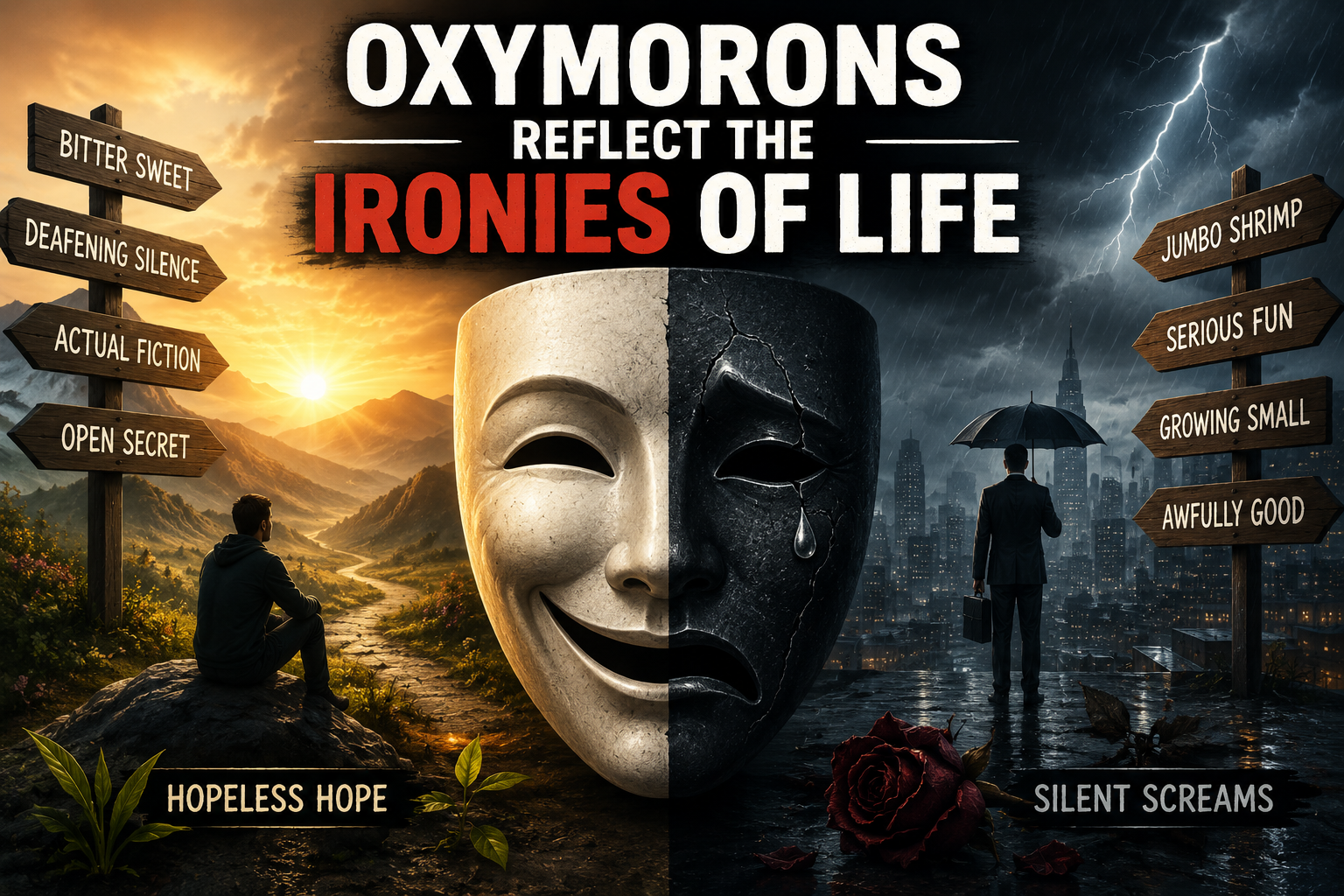
Oxymorons Reflect the Ironies of Life
An oxymoron is a figure of speech that places two contradictory
terms side by side to create a striking effect. Phrases such as “deafening
silence,” “bittersweet memory,” “living dead,” or “cruel
kindness” appear illogical at first glance, yet they capture a deeper
truth. Life itself is full of such contradictions. What appears consistent on
the surface often conceals tension, paradox, and irony underneath. The
statement “Oxymorons reflect the ironies of life” is therefore not
merely a literary observation; it is a profound commentary on the human
condition. From an Indian perspective, this insight finds rich expression in
philosophy, history, society, politics, economy, and everyday existence. Indian
thought has long recognised that reality is dual, that truth often resides in
the meeting of opposites, and that wisdom lies in holding contradictions
without forcing premature resolution.
The
Philosophical Roots of Contradiction in Indian Thought
Indian civilisation has never shied away from paradox. The
Upanishads speak of the Absolute as both nirguna (without attributes)
and saguna (with attributes). The Bhagavad Gita presents Krishna urging
Arjuna to fight while remaining detached—an apparent contradiction between
action and renunciation that resolves into the higher synthesis of nishkama
karma. The famous line “I am the beginning, the middle, and the end”
coexists with the teaching of non-attachment. Such formulations are oxymoronic
in spirit: they assert that the infinite can be finite, that the eternal can
enter time, and that freedom can be found through disciplined engagement with
the world.
The concept of maya further illustrates this irony. The world is
real enough to demand ethical action, yet ultimately illusory when measured
against the Absolute. Adi Shankaracharya’s Advaita Vedanta holds that the self
is already free, yet the seeker must strive for liberation. This is the classic
oxymoron of spiritual life: effort is required to realise that effort is
unnecessary. Rabindranath Tagore captured a related irony when he wrote of the
“infinite in the finite,” reminding us that the boundless is experienced
only through the limited. These philosophical oxymorons prepare the Indian mind
to accept that life’s deepest truths often appear as contradictions.
Freedom Through
Struggle and Non-Violence Through Strength
Indian history is replete with situations that embody the ironies
suggested by oxymorons. The freedom struggle itself was a grand oxymoron: a
movement that sought swaraj through ahimsa. Mahatma Gandhi’s method of
non-violent resistance was not passive weakness; it was organised strength. The
phrase “peaceful warrior” or “militant non-violence” captures the
essence. Gandhi turned the apparent contradiction into moral force. He insisted
that true courage lay in absorbing violence without retaliating, thereby
exposing the moral poverty of the oppressor. The Salt March, the Quit India
movement, and countless satyagrahas demonstrated that the weak could defeat the
strong by refusing to accept the logic of strength.
Partition in 1947 remains one of the most painful ironies of modern
Indian history. Independence was born alongside communal slaughter. The land of
Vasudhaiva Kutumbakam witnessed the creation of two nations amid rivers of
blood. Freedom and division, celebration and mourning, arrived together. The
phrase “bitter independence” is not rhetorical excess; it describes the
lived experience of millions who crossed newly drawn borders. The oxymoron of “divided
unity” continues to shape Indo-Pak relations and the internal politics of
identity.
Even the Indian Constitution embodies creative tension. It is both
a document of continuity with the past and a radical break from it. It protects
individual rights while recognising group identities; it is secular yet
accommodates religion; it is federal yet strong at the centre. These balances
are deliberate oxymorons designed to hold a diverse civilisation together. Dr.
B.R. Ambedkar understood that pure consistency could fracture the nation; only
a carefully managed set of contradictions could sustain it.
Progress and
Prejudice, Tradition and Modernity
Contemporary Indian society offers daily illustrations of
oxymoronic reality. Rapid economic growth coexists with persistent poverty.
Smart cities rise beside sprawling informal settlements. Digital India expands
access to information while deepening the digital divide. The phrase “inclusive
growth” often functions as an oxymoron in practice when benefits remain
concentrated. The irony is sharp: a nation that produces world-class software
engineers still struggles to provide basic sanitation and quality primary
education to large sections of its population.
Gender relations present another layered paradox. India has
produced women leaders of global stature—Indira Gandhi, Pratibha Patil, and
countless scientists, entrepreneurs, and artists—yet continues to confront
female foeticide, domestic violence, and workplace discrimination. The “empowered
yet vulnerable” woman is a lived oxymoron for many. Social media amplifies
both progressive voices and regressive trolling. The same technology that
enables women to organise and speak also becomes a tool for harassment. “Connected
isolation” describes the experience of many young people who have hundreds
of online friends yet feel profoundly alone.
Caste presents one of the most enduring ironies. Constitutional
abolition of untouchability coexists with everyday practices of exclusion.
Reservations, intended as instruments of justice, sometimes harden identity
politics. The phrase “egalitarian hierarchy” captures the tension: a
society that formally rejects hierarchy continues to organise social life
around it in subtle and overt ways. Reformers from Jyotirao Phule to Periyar to
contemporary activists have pointed out that the struggle against caste is
itself full of contradictions—demanding both radical equality and recognition
of historical difference.
Political and
Economic Ironies
Indian democracy is frequently described as a miracle and a mess
simultaneously. It is the world’s largest democracy, yet electoral politics
often rewards identity, money, and short-term populism over long-term
governance. The “mature yet immature” democracy is an oxymoron that
observers return to repeatedly. Coalition governments that appear unstable have
sometimes delivered more inclusive policies than single-party majorities. The
irony of “strong leadership producing weak institutions” or “weak
governments producing resilient institutions” appears in different phases
of the republic’s history.
Economically, India presents the spectacle of “poverty amid
plenty.” It is a nuclear power with a significant space programme, yet
ranks poorly on many human development indicators. The informal sector employs
the majority of the workforce while the formal sector captures most policy
attention. Globalisation has created both opportunity and vulnerability. The
phrase “global village with local walls” describes a country that
participates vigorously in world trade and technology while remaining deeply
protective of cultural particularities. Liberalisation after 1991 produced
growth and inequality in the same breath. The oxymoron of “market-driven
socialism” or “state-led capitalism” continues to define policy
debates.
Environmental challenges sharpen the irony further. India aspires
to rapid industrialisation while claiming leadership in climate negotiations.
The “green growth” agenda is itself an attempt to reconcile opposites.
Development that destroys the ecological base on which it rests is the ultimate
irony. Traditional practices of living lightly on the earth coexist with modern
patterns of consumption that strain resources. The oxymoron of “sustainable
excess” haunts contemporary aspirations.
Personal and
Existential Dimensions
Beyond the collective, oxymorons illuminate individual experience.
Love is often “sweet sorrow.” Ambition brings both fulfilment and
emptiness. Success can feel like failure when it costs relationships or health.
In a society that still values family, the nuclear family and individual
aspiration create new tensions. The young professional who is “independent
yet dependent” on parental support, or the migrant who is “at home in
homelessness,” lives these contradictions daily.
Ageing in a changing society produces its own ironies. Elders who
once commanded authority now navigate a world of rapid technological change.
The “wise yet outdated” parent and the “knowledgeable yet
inexperienced” child reverse traditional hierarchies. Mental health
discourse has grown more open, yet stigma persists. The phrase “open silence”
around psychological suffering captures a society that is beginning to talk yet
still struggles to listen fully.
Literature and cinema in India have long explored these ironies.
From Premchand’s stories of rural hardship to contemporary novels that examine
urban alienation, writers return to the gap between appearance and reality.
Bollywood itself is an industry of oxymorons: mass entertainment that
occasionally produces profound art, commercial formulas that sometimes yield
genuine emotion. The “formulaic originality” of popular cinema mirrors
larger cultural patterns.
The
Constructive Power of Embracing Irony
Recognising that oxymorons reflect the ironies of life is not an
invitation to cynicism. It is an invitation to maturity. A mind trained to hold
contradictions is less likely to be captured by simplistic ideologies. Indian
philosophical traditions offer resources for this maturity. The middle path of
the Buddha, the synthesis of the Gita, the pragmatic idealism of Gandhi, and
the constitutional balancing acts of the republic all suggest that progress
often lies in managing rather than eliminating tension.
Policy-making that acknowledges irony is more realistic. Education
that teaches students to live with complexity prepares them better for
citizenship. Public discourse that tolerates ambiguity is healthier than one
that demands total consistency. The ability to say “both… and…” rather than
“either… or…” is a civilisational strength when exercised with honesty and
responsibility.
Yet there is a danger. Endless celebration of paradox can become an
excuse for inaction. Some contradictions must be resolved through reform,
struggle, and institutional change. The oxymoron of “democratic
authoritarianism” or “inclusive exclusion” cannot be romanticised
indefinitely. Critical judgment remains essential. The task is to distinguish
productive tensions that generate creativity from destructive contradictions
that demand transformation.
Living the
Paradox Wisely
Oxymorons are not linguistic curiosities. They are mirrors held up
to life. In the Indian context, they reflect a civilisation that has long
understood that reality is multi-layered, that truth often appears in opposite
forms, and that wisdom consists in navigating rather than denying complexity.
From the philosophical insights of the Upanishads and the Gita, through the
historical ironies of the freedom struggle and Partition, to the contemporary
paradoxes of growth and inequality, tradition and modernity, democracy and its
discontents, the pattern is consistent. Life repeatedly places us in situations
where opposites coexist and demand simultaneous attention.
To live wisely is to recognise these ironies without being
paralysed by them. It is to act decisively while remaining open to revision, to
pursue justice while acknowledging human fallibility, to celebrate progress
while remaining alert to its costs. The phrase “confident humility”
captures the attitude required. India, with its deep reservoirs of
philosophical reflection and its turbulent democratic experience, is uniquely
positioned to cultivate this attitude. When oxymorons are understood as
reflections of life’s ironies rather than mere linguistic tricks, they become
tools of insight. They remind us that the path forward is rarely straight, that
clarity often emerges from tension, and that the human task is to hold the
opposites long enough for a higher understanding to appear. In that patient
holding lies both the challenge and the promise of a mature civilisation.